Bone Density Scanning in China: Who Needs It and What the Numbers Mean
Should You Ask for a Bone Density Scan After a Few Years in China?
A patient in her early fifties came to me last spring worried that the soy-milk-and-running routine she kept back home had slipped since moving to Shenzhen. She had not broken anything, but her mother had a hip fracture at 60 and she wanted a number, not reassurance. What she needed was a bone mineral density scan, in clinical terms a DXA or DEXA study of the lumbar spine and both hips. It is a ten-minute, low-dose X-ray that produces the single most useful number for predicting fracture risk in the next decade, and it is one of the cheapest imaging tests you can get in China.
If you are a foreign resident in China, this exam is easy to get and cheap by Western standards, but the report language and the reference ranges differ from what you may have seen abroad. Below is how the test works here, who benefits, what it costs, and how to read the result without panic.
What a Bone Density Scan Measures
The machine compares your bone mineral content against two references at once. The T-score sets your bones against a healthy 30-year-old of the same sex and ethnicity. The Z-score compares you against people your own age and sex. The scan itself is a central DXA of the lumbar spine and femoral neck, the sites that predict hip and vertebral fracture best. Some clinics also offer a heel ultrasound, but that is a screening tool only and not accepted for diagnosis or treatment decisions.
The radiation dose is tiny, roughly one-tenth of a chest X-ray, and the exposure is brief. That said, any ionising radiation is avoided in pregnancy unless the benefit clearly outweighs the risk, so tell the technician if there is any chance you are pregnant. For children and teenagers a different reference database is used, and the Z-score, not the T-score, is the one that matters.
Who Actually Needs One in China
The clearest candidates are women aged 65 and over, and men aged 70 and over, even with no symptoms. Below those ages, testing is worth it if you have a parental history of hip fracture, a previous low-trauma fracture after age 50, early menopause before 45, or long-term use of glucocorticoids such as prednisone for more than three months. Thin build, heavy smoking, three or more daily alcohol units, and rheumatoid arthritis also push you into the test-me group.
People on long-term thyroid hormone, those with untreated hyperthyroidism, and anyone who has had a gastric bypass should ask too. In China the test is also routinely offered inside the health checkup packages China sold to expats over 50, so you may already have a baseline from your company physical without realising it. A useful rule of thumb: if you have had two or more of the risk factors above for more than a year, the scan pays for itself in the worry it removes.
Booking the Exam and Getting Ready
Public hospitals list the scan under the bone density room inside radiology or endocrinology. You book it the same way as any outpatient test: register, see the doctor, get the order, then queue at the machine. Private clinics and many international hospitals let you book the DXA directly through reception, sometimes on the same day. No injection and no fasting are required.
Preparation is light but specific. Stop calcium supplements and any pill containing calcium for 24 hours before, because residual calcium in the gut can skew the reading. Wear loose clothing with no metal zips or buttons around the waist and hips; a tracksuit works well. Remove belts, wallets and phones from your pockets. If you had a barium study, CT with contrast, or a nuclear medicine scan within the previous two weeks, wait, because residual material interferes with the image.
A Typical Scan Day
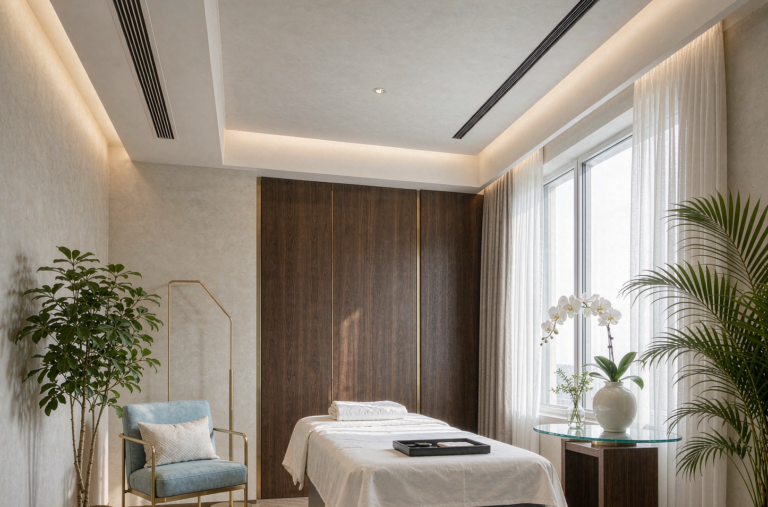
You lie on a padded table while a movable arm passes slowly over your lower spine and hip. The technologist leaves the room during the exposure but watches through a window. You must stay still for the few seconds each position takes. There is no enclosed tunnel, no noise beyond a soft hum, and no injection. Most people read their phone between positions. The whole appointment, including changing and positioning, runs ten to twenty minutes, with the actual scan time closer to five.
How Long Until You Get the Number
In a private clinic the radiologist often dictates a report the same afternoon, and your doctor reviews it at the following consultation. In a busy public hospital the image is read within one to three working days and the printed report is collected at a self-service kiosk. Unlike blood tests there is nothing to process biologically, so the delay is purely administrative. If the scan was part of a larger check-up, expect the consolidated report within a week.
What the Scan Costs
Estimates only — final costs are determined by the hospital.
- Public tier-3 hospital, central DXA of spine and hip: roughly 200 to 500 RMB, about 28 to 70 USD.
- Private international hospital or clinic: roughly 600 to 1,500 RMB, about 85 to 210 USD, usually with an English report and faster slot.
- Heel ultrasound screening at a community centre: often free to 100 RMB, about 0 to 14 USD, but not diagnostic.
- Follow-up scan at one to two years to track treatment: same price band as the first.
Public pricing follows the provincial schedule and is identical for locals and foreigners. If your insurer covers preventive screening, the private charge may be reimbursed; keep the itemised invoice and the diagnostic code the doctor prints on the order.
Reading the T-Score Without Panic
A T-score above minus 1.0 is normal. Between minus 1.0 and minus 2.5 is osteopenia, meaning lower-than-young-adult bone but not yet osteoporosis. At or below minus 2.5 the diagnosis is osteoporosis. A Z-score markedly below minus 2.0 in a younger person prompts the doctor to look for secondary causes such as thyroid disease or malabsorption, not just to prescribe a pill.
The report also gives a ten-year major osteoporotic fracture probability in some Chinese centres, calculated from local population data. Treat the number as a trend, not a verdict. One low scan in a small person can shift a full point with a better positioning next time, which is why technique matters more than people expect. For the broader picture on living with thinning bone, the osteoporosis bone health China resources explain diet, sunlight and fall-prevention steps that pair with the scan. A single score is a snapshot; the year-on-year direction is what your doctor acts on.
Mistakes That Make the Result Useless
- Taking a calcium tablet the morning of the scan, which fogs the gut image.
- Wearing jeans with metal studs or a belt, forcing a re-positioning and a weaker read.
- Comparing a Chinese DXA T-score directly to a scan done on a different machine abroad; always compare the trend, or repeat on the same model.
- Reading the Z-score as if it were the T-score after age 50; past menopause the T-score is the diagnostic one.
- Assuming a normal scan means you can skip strength training; bone responds to load, not to a clean report.
Public Hospital or Private Clinic for a DXA
For a plain diagnostic scan there is little clinical difference; the public machines in tier-3 hospitals are the same makes used privately. Choose public for the lowest cost and private if you want the report in English and a doctor who walks you through the fracture-risk calculation face to face. If the scan is part of a wider Healthcare in China work-up, bundling it with blood tests on one visit saves a second trip. Either route, ask for the raw T-score and the fracture-risk figure in writing so you can track it next time.
Questions Foreign Patients Ask
How often should I repeat the scan?
If you are stable and not on osteoporosis treatment, every two years is standard, because bone changes slowly and earlier repeats mostly capture machine noise. If you start medication, the first follow-up is usually at one year to confirm the drug is working, then every one to two years after.
Is the radiation dangerous for me or my child?
The dose is extremely low and focused on the pelvis and spine. It is not recommended during pregnancy as a precaution, and children are scanned with a different reference set, but for an adult the exposure is a fraction of a single flight’s cosmic radiation. The benefit of finding silent bone loss early far outweighs it.
Can I get the scan without seeing a doctor first?
In private clinics, often yes, as a self-requested screening. In public hospitals you generally need a doctor’s order, because the scan is billed as a clinical test. If you already have a check-up report showing low vitamin D, bring it; the doctor will usually approve the DXA on the spot.
Will insurance pay for it if I have no symptoms?
Some international plans cover one baseline DXA per year for over-50s as preventive; others only after a fracture or a flagged risk. Check the preventive-care section of your policy rather than assuming, and keep the diagnostic order as proof it was clinician-directed.
A Note on Scope
This guide explains how bone density scanning is arranged for foreign residents in China and is not a substitute for personal medical advice. Whether you need the scan, and what a given score means for your treatment, must come from a doctor who knows your full history. Karl Huang, Technical Director at Tianyou Medical Research Institute, certified health manager, Chinese medical companion specialist, and expert consultant at Zhong’an Kanghua Outpatient, wrote this from experience supporting expatriate patients, but it does not replace a consultation. Please review our medical disclaimer and our editorial policy for how we handle medical content and claims.