Hospitals in Shenzhen for International Patients: A Practical Guide
Hospitals in Shenzhen for International Patients
Shenzhen is often the most convenient Chinese city for visitors arriving through Hong Kong, China, and it has a dense network of public tertiary hospitals, district hospitals and private clinics. That convenience is real, but the city’s hospitals are spread across several districts and their departments are not interchangeable. This guide explains how the system is arranged, how to register with a passport, which channels offer English-language coordination, and how to plan a first appointment without losing a morning to the wrong campus.
Choosing a type of provider in Shenzhen
| Tertiary public hospital | Broad specialties and advanced imaging | Complex assessment, surgery, second opinions |
|---|---|---|
| International department | Separate desk and English coordination | Visitors wanting one booking channel |
| District hospital | Shorter queues for routine care | Simple tests and repeat prescriptions |
| Private clinic | Longer appointments, English-speaking staff | Consultations and basic diagnostics |
How Shenzhen’s hospital network is laid out
Shenzhen’s public hospitals are distributed across districts rather than concentrated in one medical quarter. Large tertiary centres serve the whole city and beyond, while district hospitals and community health centres handle routine care closer to residential areas. Several major hospitals also operate more than one campus, and the department you need may be at only one of them.
For a visitor this geography matters as much as the hospital’s name. Travel between districts can take a substantial part of a morning, and an appointment confirmation that lists only the hospital’s main address may point you to the wrong building. Always confirm the street address of the specific department, the building and the floor before setting out.
Registering with a passport
A first visit begins with creating a patient record, and for an international patient that normally means registering with a passport at a counter rather than at a self-service kiosk. Use the same passport and the same spelling of your name for every subsequent test, prescription and invoice, because all of them attach to that original record.
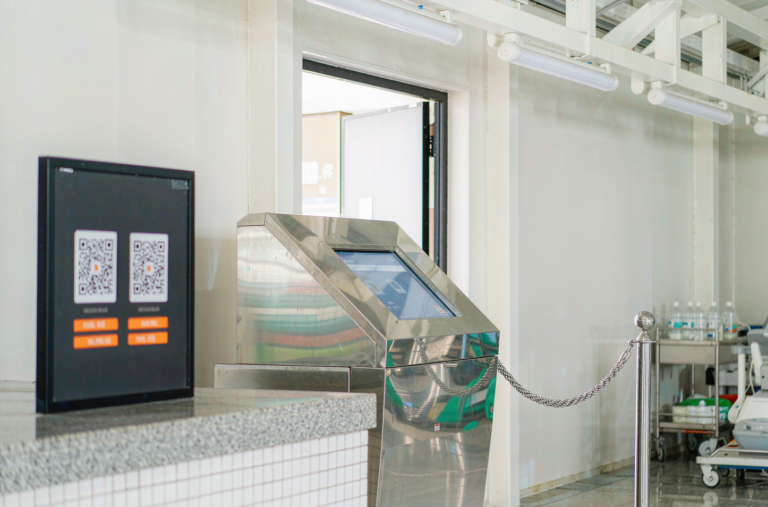
Self-service registration frequently expects a local mobile number or a resident ID, which visitors do not have. International desks can often complete registration manually, while general kiosks may not. Ask in advance whether a local phone number is needed for the booking channel you plan to use, and arrive early enough to handle the counter step before your appointment slot.
For more detail, see how to book a Shenzhen appointment.
Where English-language support is available
Several large public hospitals in Shenzhen run a separate international or VIP outpatient department with its own appointment desk, longer consultation slots and staff who can coordinate in English. This is a booking and coordination channel inside the same hospital, giving access to the same departments and equipment, not a separate institution with different doctors.
Private clinics offer another route, usually with longer appointments and more consistent English support, though their on-site diagnostic range can be narrower. Many visitors combine the two: a private consultation to define the question, then a public tertiary centre for imaging or a procedure. Request an interpreter when booking rather than on arrival, and bring a written one-page history in simple English.
Booking an appointment that actually happens
Appointment slots are released through hospital apps, telephone lines, on-site counters and international desks, and the release windows differ by department. Specialist slots at busy tertiary centres can disappear quickly. The sequence that works best is to secure the appointment first, then book travel and accommodation around it.
Confirm four things in writing: the exact department and sub-clinic, the campus address, whether an on-site check-in is still required after booking online, and whether any fasting or preparation applies. A slot booked through an app often still needs to be validated at a kiosk or counter on the morning, which is a common surprise for first-time visitors.
The surrounding process is covered in understanding hospital registration.
What a first visit looks like
A typical public hospital visit runs in stages: registration, department check-in, consultation, payment for any investigations ordered, the tests themselves, a wait for results, and often a return to the clinician with those results. What was planned as a one-hour appointment can occupy most of a morning, particularly if imaging or laboratory work is added.
Bring your passport, previous reports and original imaging, a list of current medicines using generic names, and a short written summary of the question you want answered. Before leaving, collect the printed reports, the prescription and an itemised receipt from the relevant desks. If your insurer needs an English summary, ask for it at booking so the request is attached to the appointment.
Planning around the border and your stay
Shenzhen’s proximity to Hong Kong, China makes short visits feasible, but border crossing times and peak-hour road traffic should be part of the plan. Avoid scheduling a first specialist appointment and a return crossing in the same narrow window, and consider staying near the hospital rather than near the crossing if investigations may run late.
If a procedure or a course of follow-up appointments is possible, ask the clinician for the expected review dates before booking a return flight. Travellers who need to extend a stay should also keep the appointment confirmation and hospital letters together, since administrative offices may be asked to provide an updated letter. For wider itinerary planning, see our medical tourism guide.
See also accommodation near treatment before you book.
Where visitors commonly start: eyes, teeth and children
Not every trip to a Shenzhen hospital begins with a complex diagnosis. Many visitors first need dental work, an eye examination, a paediatric consultation or a routine screening, and these services are organised differently from tertiary inpatient care. Specialist eye and dental hospitals often run their own appointment systems, while children are usually seen in a dedicated paediatric department rather than a general adult clinic.
For these services, check whether the provider is a hospital department or a standalone clinic, because it affects what diagnostics are on site and what an insurer will accept as a receipt. Bring previous prescriptions, dental records, a child’s vaccination history, or an existing glasses prescription as appropriate. For a screening result that needs follow-up, a centre attached to a large hospital makes referral into the relevant department simpler. Ask whether results are issued on the same day, since that often determines whether a single visit is enough.
Appointment lengths and the availability of English-speaking staff vary more in these ambulatory specialties than in tertiary inpatient departments, so it is worth asking who will see you and whether a written treatment plan will be provided before you commit to a course. If treatment spans several visits, ask at the outset how the appointments would be spaced, what each is expected to cost, and whether the records can be transferred to a clinician in another city or country. Families should also confirm what identification a child needs at registration, since a child without a local resident ID is usually registered against a parent’s passport and the hospital’s own record number. Keep the itemised receipts together, because a multi-visit course is easier to claim back when the paperwork forms one continuous set. Confirm current charges with the provider; estimates only — final costs are determined by the hospital.
Frequently Asked Questions
Can I register at a Shenzhen hospital without a Chinese ID?
Yes, international patients normally register with a passport at a staffed counter. Self-service kiosks often expect a local mobile number or resident ID, so use the international or manual registration desk.
Do Shenzhen hospitals have English-speaking staff?
Several large public hospitals run international departments with English coordination, and private clinics commonly offer English-language consultations. Request an interpreter at the time of booking rather than on arrival.
Which district should I stay in?
Stay near the campus where your appointment is booked rather than near a border crossing. Confirm the department’s street address first, since some hospitals operate several sites.
Can I get my reports in English?
International departments often provide an English summary, but public hospital printouts are usually in Chinese. Ask when booking and keep the original reports and imaging as well.
A Note on Scope and Affiliation
This guide is provided for general information only and is not medical advice, a diagnosis, or a recommendation for any specific treatment. It does not replace a consultation with a qualified clinician, who will determine what is appropriate for your individual circumstances. Hospital departments, appointment channels, document requirements and fees can change; confirm current arrangements directly with the hospital before you travel. Any cost references are estimates only — final costs are determined by the hospital.
HealthcareHubChina is an independent information resource. Our editorial process, sourcing standards and corrections policy are described in our editorial policy. For a full planning sequence covering visas, costs, cities and accommodation, see our Medical Tourism in China guide.